Collective Requests are BioEden's mission system, and they are more interesting than a typical quest log because you choose between competing offers from different guilds, and the offers pull your planet in genuinely different directions.
How the system works
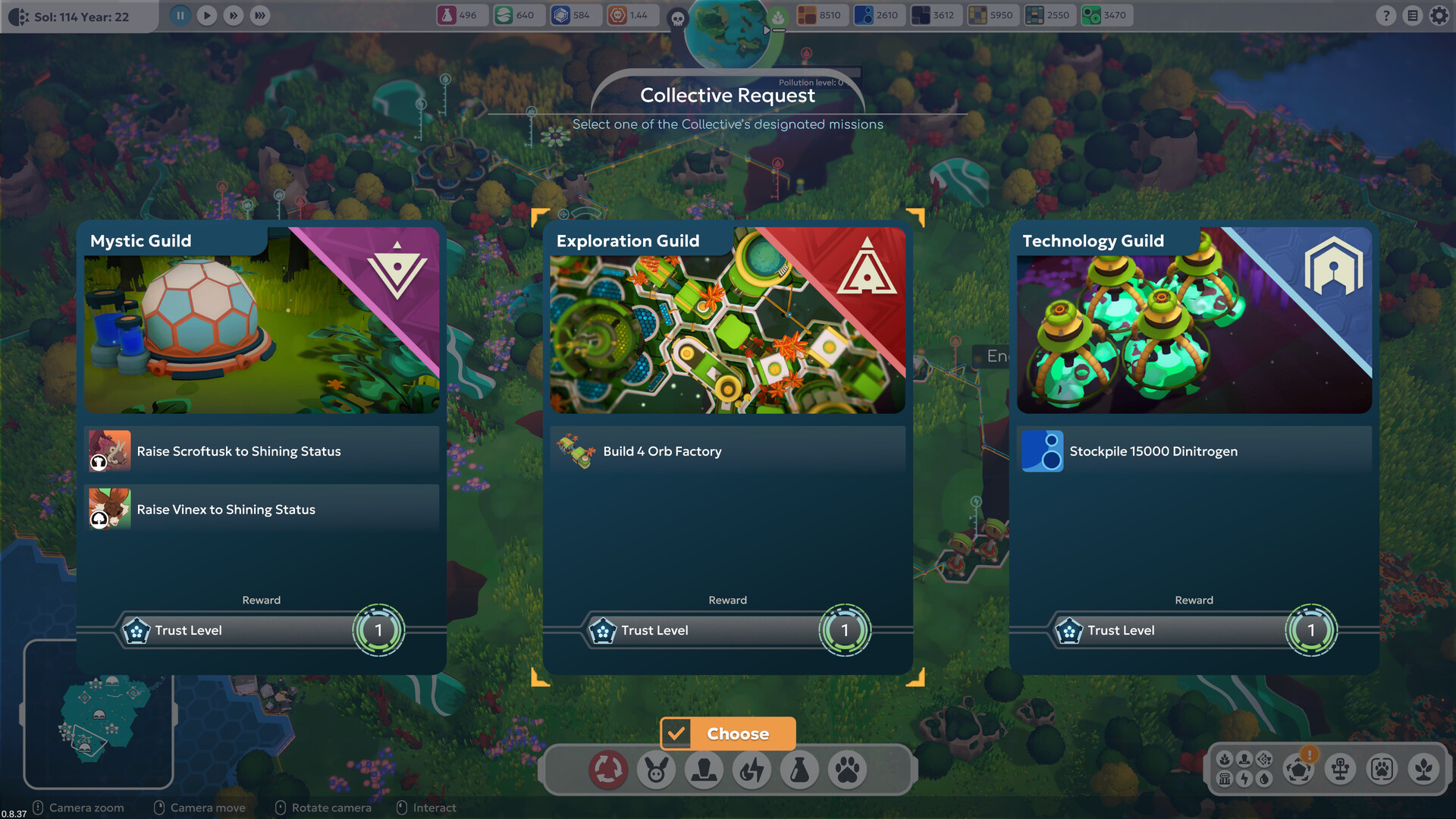
The Collective Request screen presents cards from different guilds and asks you to *“select one of the Collective's designated missions”*. Each card lists its objective and its reward. From official screenshots, the reward is Trust Level, and the three simultaneous offers were:
| Guild | Objective | What it really costs you |
|---|---|---|
| Mystic Guild | Raise Scroftusk to Shining Status; Raise Vinex to Shining Status | A long animal husbandry project on two specific species |
| Exploration Guild | Build 4 Orb Factory | 4× the confirmed single-factory figures: 6000 + 4000 materials, 200 power, +140 pollution |
| Technology Guild | Stockpile 15000 Dinitrogen | A pure economic grind with no pollution cost |
Other requests seen in official material include “Reduce the Impact Level to 19%” and “Raise Knowledge of Prairie to Level 6 in the Biome Knowledge Tree”, so the system spans building, economy, ecology, cleanup and research.
How to choose
The instinct is to take whichever looks quickest. That is usually wrong, because the requests differ enormously in hidden cost.
“Build 4 Orb Factory” is the trap card. It is fast if you have materials, and it saddles your planet with four buildings that each carry a confirmed +35 pollution effect and a 50 power draw, permanently, unless you recycle them afterwards. Four of them is therefore a +140 pollution commitment — that figure is simple multiplication of the values shown in the building's own tooltip, not an estimate. Taking it when your Impact Level is already elevated is how players end up staring at four Active Regulations. Taking it early, on a clean planet, with a plan to recycle two of them once the request completes, is entirely reasonable.
Stockpiling requests are the safe pick. “Stockpile 15000 Dinitrogen” costs time and nothing else. No pollution, no permanent structures, no ecological consequence. If you are trying to stabilise a planet, take these.
Animal husbandry requests are the slow pick with the best side effects. Raising a species to Shining Status is a long project, but it is a project you probably wanted to do anyway, and it does not damage anything. The risk is purely that it takes many Sols and you may need the Trust Level sooner.
Cleanup requests are free value. “Reduce Impact Level to 19%” asks you to do the thing you should be doing regardless, and pays you for it.
Trust Level
Trust Level is the reward currency. Nothing published explains its full spending curve, so we will not invent one. What is observable is that each completed request grants Trust Level 1, and that requests come from specific guilds — which implies standing with individual guilds rather than a single global reputation.
Practical advice
- Read the pollution implication before you accept. Any request that asks you to build industry is a pollution commitment. Multiply the building's Effects value by the quantity asked for.
- Check your Impact Level first. If it is already elevated, decline industry requests and take stockpiling or cleanup instead.
- Match requests to your Knowledge Tree. A request naming a biome you have never developed is not worth restructuring your campaign for.
- Recycle after completion where possible. If a request asked you to build four of something and you only need two, the refund is full. Just confirm the request has actually completed first.
- Do not treat requests as mandatory. There is always more than one on offer. Declining is a legitimate strategy, not a missed opportunity.
Requests and the difficulty curve
Collective Requests are where BioEden's gentle systems acquire teeth. Nothing else in the game will actively invite you to build four of its most polluting structure. The game is not being unfair — it is offering you a genuine trade and trusting you to read the tooltip. That is a better piece of design than it first appears, and it is why pollution and Impact Level is worth reading before you accept your third or fourth request.
Frequently asked questions
What are Collective Requests in BioEden?
Missions issued by the Collective's guilds. You are shown competing offers and select one. Each grants Trust Level on completion.
Do I have to accept every Collective Request?
No. Declining is a legitimate strategy. Requests that ask you to build industry carry a permanent pollution cost, so declining one when your Impact Level is already high is often the right call.
What is Trust Level in BioEden?
The reward currency granted by completing Collective Requests. Each completed request seen in official material grants Trust Level 1. Its full spending curve has not been published.
Is 'Build 4 Orb Factory' worth doing?
Only on a clean planet with a plan. One Orb Factory's own tooltip confirms 1500 + 1000 materials, a 50 power draw and a +35 pollution effect, so four is exactly 6000 + 4000 materials, 200 power and +140 pollution. Recycling surplus factories after the request completes recovers the materials but not the pollution already emitted.
How this BioEden page was verified
BioEden Wiki & Guide is an independent fan resource, not an official one. The gameplay systems described on this page were checked against official BioEden screenshots released by Focus Entertainment, and against the systems described on the official Steam store page. Where BioEden has not published a value, this page says so instead of guessing, because a wrong number in a BioEden guide costs a reader a dome rather than merely being untidy. Spot something out of date after a BioEden patch? Send us a correction and we will fix it and log it on the BioEden news page.
Primary sources: BioEden on Steam · Focus Entertainment · Official Steam discussions · official in-game screenshots. Last reviewed .