BioEden has five biomes, and they are the organising principle for almost everything else in the game: the Bestiary is tabbed by biome, research is tracked per biome in the Biome Knowledge Tree, and every dome you build is effectively a commitment to one climate band.
| Biome | Character | Confirmed region names | Documented species |
|---|---|---|---|
| Jungle | Hot and very humid. The tutorial biome. | "Jungle" | Landowl, Ributs, Fimble, Slink, Basker, Mirra, Thudder |
| Forest | Temperate. Official screenshots show a red-canopy variant. | "Red Forest" | Not yet documented |
| Prairie | Dry open grassland with watering holes. | "Purple Crystal Prairie" | Not yet documented |
| Savannah | Hot and dry. | Not yet documented | Not yet documented |
| Tundra | Cold. Screenshots show a heavily damaged variant. | "Burnt Tundra" | Not yet documented |
Region names in BioEden are not the same as biome names. The globe widget in official screenshots shows labels like *Purple Crystal Prairie*, *Red Forest* and *Burnt Tundra* — a descriptive prefix plus the underlying biome. Two Prairie regions on the same planet can look entirely different and carry very different pollution levels while sharing the same Bestiary tab.

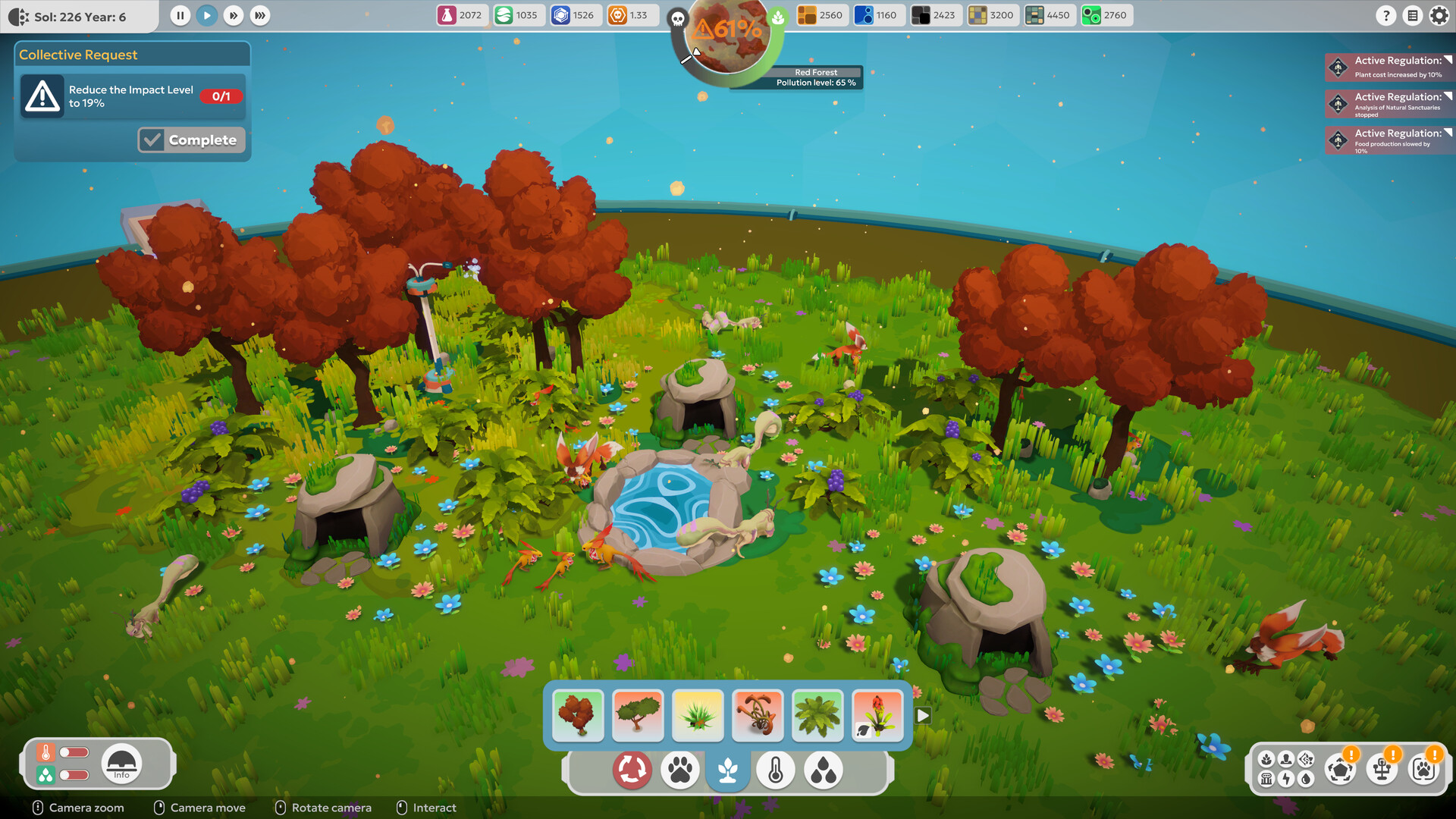
How a biome dome is actually built
A BioEden dome starts as an empty shell with whatever ambient climate the region gives it. Turning it into a functioning biome means three passes:
- Climate. Push temperature and humidity into the band your target species needs, using humidifiers, air
conditioners and water features. This is covered in detail on the temperature and humidity page.
- Vegetation. Place the plants the species requires. The dome build palette is biome-specific: the Red Forest
palette in official screenshots offers red-canopy trees, green trees, grasses, mushrooms, ferns and flowers. Plants are simultaneously a requirement, a food source and a decoration contributor.
- Furniture and water. Burrows, rock formations and a watering hole. These push the decoration value that
Residency checks, and the watering hole in particular appears in every populated dome in official material.
Choosing which biome to develop first
There is a strong argument for staying in Jungle longer than feels necessary. Jungle is where your pre-unlocked species live, its cheapest unlocks are 3 and 5 DNA, and Landowl's 20–45° / 55–90% band is wide enough that a roughly-tuned dome will satisfy it. A second Jungle dome is therefore much cheaper to make successful than a first Tundra dome, because you already own the research, the plants and the climate equipment.
The counter-argument is the Biome Knowledge Tree. Because knowledge levels are tracked per biome and Collective Requests can ask for a specific biome at a specific level, a planet where you have spread thinly across five biomes will struggle to hit a "raise Knowledge of Prairie to Level 6" request. Most players are better served by two strong biomes than five weak ones.
Mixing biomes inside one dome
It is possible to run two climate bands inside a single BioEden dome by dividing the floor into wedges and placing climate devices to hold different conditions in each. It is fiddly, it costs power and water, and it introduces the predator adjacency problem in its worst form. The mixed-biome dome guide covers when it is worth it and the one rule you cannot break: never place a carnivore on the shared boundary between two wedges.
Pollution differs by region, not by biome
Nothing about being a Tundra makes a region dirty. The *Burnt* Tundra in official screenshots sits at 75% pollution because of what happened to it, and a healthy Jungle sits at 8.1%. When you scout a new region, read the pollution figure on the globe widget before you commit to a dome there — cleaning a 75% region up is a project in its own right, and the animals inside your dome are affected by the region around it. See pollution and Impact Level.
Frequently asked questions
How many biomes does BioEden have?
Five: Jungle, Forest, Prairie, Savannah and Tundra. They appear as the five tabs in the Bestiary and as separate branches of the Biome Knowledge Tree.
Which BioEden biome should I build first?
Jungle. Two of its species are pre-unlocked, its cheapest unlocks cost 3 and 5 DNA, and Landowl's wide 20–45° band tolerates an imprecise dome.
Can one dome hold two biomes in BioEden?
Yes, by splitting the floor into climate wedges, but it costs power and water and creates predator adjacency risk. See mixed-biome domes.
How this BioEden page was verified
BioEden Wiki & Guide is an independent fan resource, not an official one. The biome names, region labels and pollution figures on this page were transcribed from official BioEden screenshots; climate bands come from the in-game Bestiary. Where BioEden has not published a value, this page says so instead of guessing, because a wrong number in a BioEden guide costs a reader a dome rather than merely being untidy. Spot something out of date after a BioEden patch? Send us a correction and we will fix it and log it on the BioEden news page.
Primary sources: BioEden on Steam · Focus Entertainment · Official Steam discussions · official in-game screenshots. Last reviewed .